Listen

Why ACP Features This Document
Understanding how we got here is essential to changing where we're headed. The Powell Memo is one of the most consequential — yet least discussed — documents in modern American political history. Written in 1971, it served as a strategic blueprint for the organized corporate and conservative political movement that has shaped U.S. policy, media, and institutions for more than five decades.
American Civic Power believes that an informed citizenry must understand the forces that have deliberately and systematically shifted political and economic power away from ordinary people. The Powell Memo is the starting point for that understanding.
Background
The Powell Memo — formally titled “Attack on American Free Enterprise System” — was a confidential memorandum written on August 23, 1971, by corporate lawyer Lewis F. Powell Jr., at the request of his neighbor, Eugene Sydnor Jr., a close friend and the U.S. Chamber of Commerce's education director.
Powell argued that American businesses were facing a sustained, coordinated attack by social movements, consumer advocates, environmentalists, and academic institutions — and that corporations had been dangerously passive in response. He warned that business leaders were “losing a war for the soul of America” and called for a long-term, organized, and well-funded campaign to fight back.
Just two months after writing the memo, Powell was nominated by President Nixon to the U.S. Supreme Court. The memo remained confidential until investigative journalist Jack Anderson obtained and published it in 1972, after Powell's Senate confirmation. Powell served on the Supreme Court until 1987.
Key Recommendations
The memo outlined a sweeping, multi-front strategy for corporate America to reclaim political and cultural influence. It presented five major recommendations:
- Fund Legal Challenges: Powell urged businesses to fund and staff legal organizations capable of challenging regulations and advancing pro-corporate interests in the courts — mirroring the success of civil rights legal organizations such as the NAACP. This directly inspired the creation of conservative public-interest law firms and organizations such as the Federalist Society.
- Build Think Tanks: Powell called for creating a stable of business-friendly scholars, researchers, and policy analysts — “scholars-on-call” — who could produce and promote pro-business ideas. This recommendation is widely credited with inspiring the founding of the Heritage Foundation (1973) and the Cato Institute (1977), among others.
- Monitor and Influence Media: Powell recommended constant monitoring of television, newspapers, and other media for anti-business bias — and aggressive demands for “equal time” to present the corporate perspective. He viewed the media as a critical battleground for public opinion.
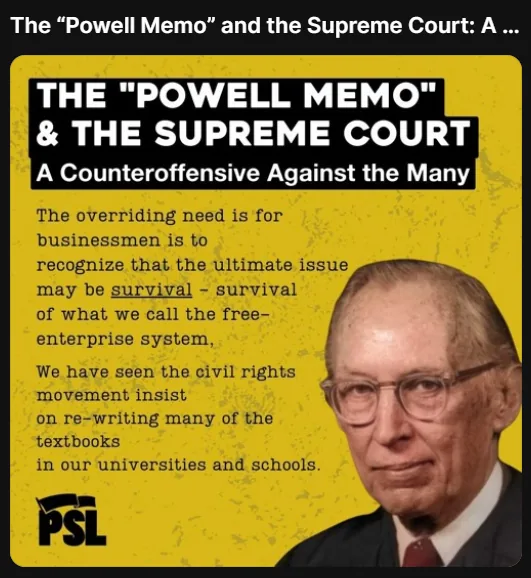
- Target Universities: Powell argued that college campuses were breeding grounds for anti-business sentiment and recommended strategies to counter it — including reviewing and challenging textbooks, promoting faculty with pro-business views, and funding speaker programs. These recommendations laid the groundwork for decades of conservative engagement with higher education.
- Become Politically Active: Perhaps most significantly, Powell urged corporations to engage directly in electoral politics by increasing lobbying, supporting pro-business candidates, and using political action committees. The memo's influence is often cited in analyses of the rise of corporate political spending, culminating in the Supreme Court's 2010 Citizens United decision.
Lasting Influence
Though its immediate impact is difficult to isolate, the Powell Memo is widely credited with catalyzing the modern conservative and corporate political infrastructure. Within a decade of its publication:
- The number of corporations with registered lobbyists in Washington rose from 175 in 1971 to more than 2,500 by 1982.
- Major think tanks, including the Heritage Foundation, the Cato Institute, and the American Enterprise Institute, expanded dramatically in funding and influence.
- The Business Roundtable — a powerful CEO lobbying group — was founded in 1972, a year after the memo.
- Conservative legal organizations and the Federalist Society began reshaping the federal judiciary from the ground up.
Whether or not the memo was directly responsible for each of these developments, it captured and articulated a strategic vision that proved enormously influential — and whose effects are still felt in American politics today.
Why It Matters Today
More than fifty years after it was written, the Powell Memo remains a critical lens for understanding today's political landscape. The infrastructure it helped inspire — think tanks, legal organizations, media networks, and political action committees — continues to shape legislation, judicial appointments, and public opinion at every level of government.
For civic advocates and grassroots organizers, the memo offers a sobering yet important lesson: organized, sustained, long-term effort can fundamentally reshape political systems. The same strategic thinking Powell applied on behalf of corporate interests can — and must — be applied on behalf of ordinary citizens.
That is exactly the mission of American Civic Power.
“The memo was a call to arms for corporate America — and it worked. Now it's time for citizens to answer with an organized response of their own.”
Resources on This Page
- The Powell Memo and the Supreme CourtLiberation News · SoundCloud
- The Lever — Master PlanPodcast · Spotify
Know the history. Build the countermovement.