Los 12 Puntos de la Buena Gobernanza: Un Marco para la Rendición de Cuentas Cívica
Good governance doesn't happen by accident. It requires clear standards, informed citizens, and leaders who are held accountable to both.
American Civic Power has developed the 12 Points of Good Governance — a nonpartisan framework that defines what functional, accountable, democratic government looks like in practice. These principles apply to any government, at any level, regardless of political affiliation. They are rooted in the American constitutional tradition and designed to give every Civestor a clear, consistent tool for evaluating the institutions that govern their lives.
“You cannot hold power accountable without a standard. The 12 Points are that standard.”
The framework
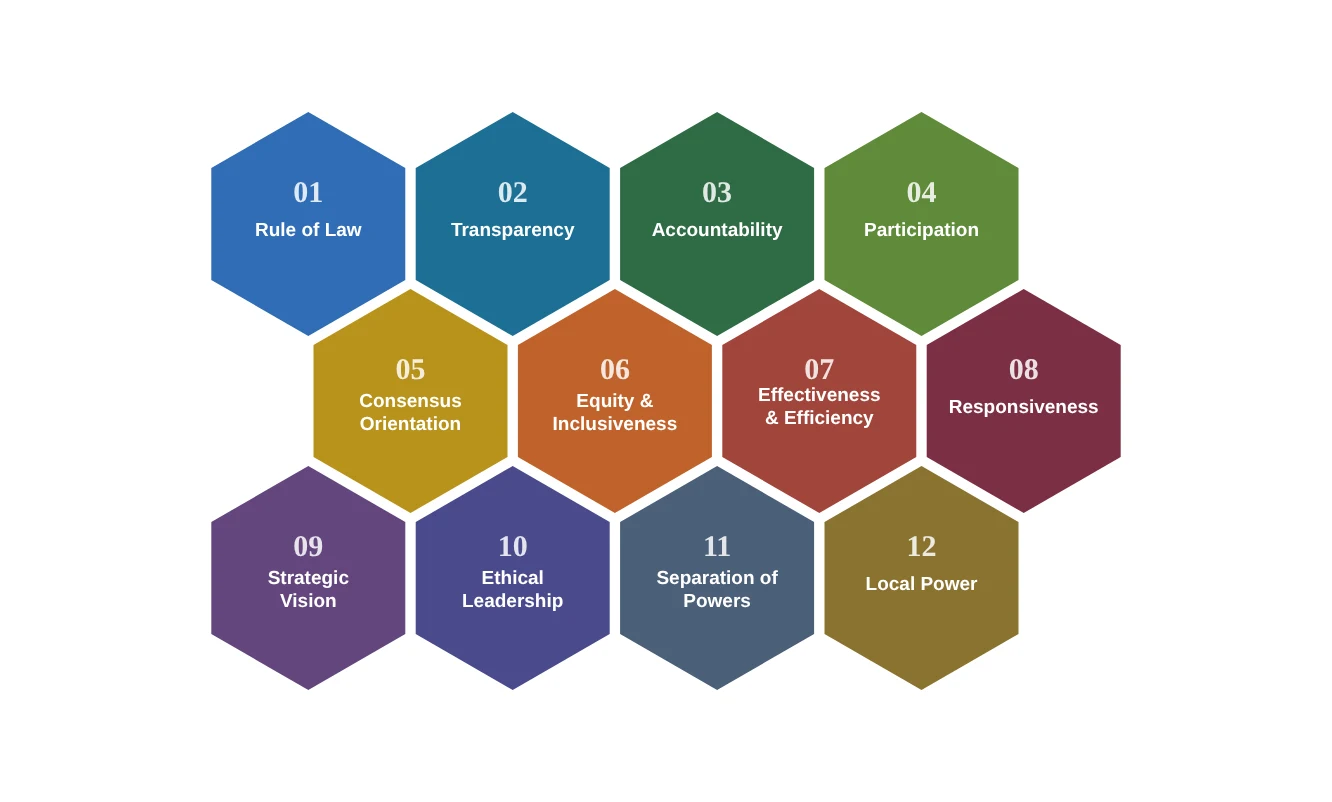
The 12 Points
From Rule of Law and Transparency to Ethical Leadership and Local Power, each of the 12 Points represents both an aspiration and a benchmark — a guide for civic leaders and a measuring stick for the rest of us. Each Point now has a 60-second video — press play on any card, or watch the series on YouTube.
Rule of Law
Good governance begins with the equal application of law — no individual or institution above accountability, and government power exercised only within legal bounds. It requires impartial enforcement, enforceable rights, and predictable rules that protect the vulnerable as much as the powerful.
Civest Sphere’s role: Civest Sphere’s FOIL-tracking and legal-transparency tools help residents confirm that public bodies are actually operating within the law — turning an abstract principle into something citizens can verify for themselves.
Transparency
Decisions and their enforcement follow rules and procedures that are open, accessible, and clearly communicated to those affected. Information flows freely, and the public can see how a choice was made — not just what was decided.
Civest Sphere’s role: Civest Sphere’s public-data dashboards — payroll, campaign finance, property assessments — convert dense government records into information residents can actually read and act on.
Accountability
Institutions and the people who lead them answer to the public and to one another. Accountability requires clear lines of responsibility, and real consequences when decisions fall short of the public interest.
Civest Sphere’s role: By putting voting records, spending, and decision-making in one place, Civest Sphere gives residents the evidence they need to hold officials accountable — at the ballot box and in between elections.
Participation
Every resident — regardless of income, background, or geography — has a genuine voice in the decisions that shape their community, exercised directly or through legitimate representative institutions.
Civest Sphere’s role: From district-leader organizing to civic-education tools, Civest Sphere’s mission is to lower the distance between residents and the institutions that govern them.
Consensus Orientation
Good governance mediates differing interests to reach broad agreement on what serves the community’s long-term best interest — and on how that path is best reached.
Civest Sphere’s role: Civest Sphere treats civic disagreement as a starting point, not an obstacle — offering shared, nonpartisan data that residents across the political spectrum can reason from together.
Equity & Inclusiveness
All members of a community feel they have a stake in its outcomes and are not excluded from the mainstream of society — particularly the most vulnerable, who need real opportunity to improve their well-being.
Civest Sphere’s role: Civest Sphere is built to serve every district, not just the ones with the loudest political voice, because equitable access to information is a prerequisite for equitable outcomes.
Effectiveness & Efficiency
Processes and institutions produce results that meet the community’s actual needs while making good use of available resources. Public trust depends on government that visibly works.
Civest Sphere’s role: Civest Sphere’s tools are built to save residents’ and organizers’ time — replacing hours of manual records research with a dashboard that surfaces the answer in seconds.
Responsiveness
Institutions and processes serve all stakeholders within a reasonable timeframe, adapting to community needs rather than requiring residents to adapt to bureaucracy.
Civest Sphere’s role: Civest Sphere’s Contact-Your-Rep and district-organizing tools shorten the distance between a resident’s concern and the official positioned to act on it.
Strategic Vision
Leaders and the public share a broad, long-term perspective on good governance and human development, grounded in the historical, cultural, and social realities that shape their community.
Civest Sphere’s role: American Civic Power’s platform is built for the long horizon — civic infrastructure meant to outlast any single campaign or election cycle.
Ethical Leadership
Those who hold public trust act with integrity, place the public interest above personal or political gain, and model the standards of conduct they ask of others.
Civest Sphere’s role: Civest Sphere was founded on the premise that civic technology should be a public good, not a partisan tool — a standard its founder holds the platform to directly.
Separation of Powers
Legislative, executive, and judicial functions operate independently of one another, each a check against the others’ overreach, so no single branch consolidates unchecked authority.
Civest Sphere’s role: Civest Sphere’s tools map how local, county, and state authorities actually divide responsibility — helping residents understand which body is accountable for which decision.
Local Power
Decisions are made as close as possible to the people they affect, with local governments and communities holding real authority over the issues closest to home.
Civest Sphere’s role: Civest Sphere is built district by district, starting on Long Island — because civic power, like good governance, is strongest when it starts local.
The 12 Points of Good Governance is a nonpartisan framework developed by American Civic Power to define what functional, accountable, democratic government looks like in practice — at every level, from your town board to Washington.